
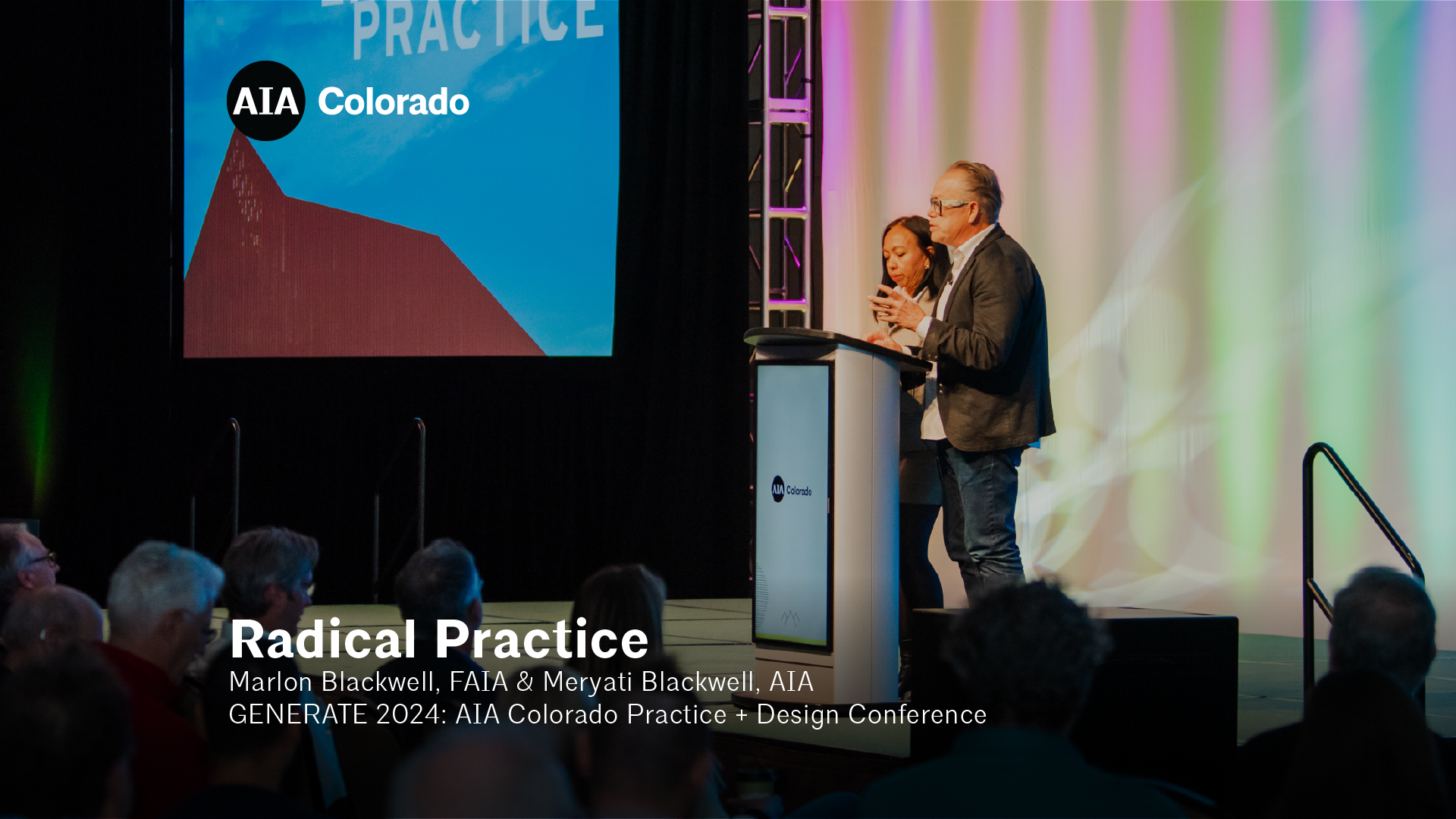
Marlon Blackwell, FAIA & Meryati Blackwell, FAIA | Radical Practice
Marlon Blackwell, FAIA & Meryati Blackwell, FAIA | Radical Practice
GENERATE 2024 Practice + Design Conference Keynote
Presented at the 2024 AIA Colorado Practice + Design Conference, Marlon Blackwell, FAIA, and Meryati Blackwell, AIA, of Marlon Blackwell Architects explore how architecture grounded in the fundamentals of place, material, purpose, and resourcefulness can become a powerful force for transformation.
In Radical Practice, the Blackwells reclaim the word “radical” through its origins in the idea of the root. For their Fayetteville, Arkansas-based practice, being radical is less about novelty or rebellion than maintaining fidelity to architectural fundamentals while engaging deeply with the specific conditions of a place. Their work demonstrates that consequential architecture can emerge anywhere—and often from circumstances defined by limited resources, overlooked contexts, or unconventional opportunities.
Drawing from projects across Arkansas and an increasingly national and international portfolio, the Blackwells examine an approach that connects local culture and material traditions with broader architectural ideas. They describe these relationships as “abstract unions”: productive tensions between local and global influences, theory and practice, economy and expression. The goal is an economy of means capable of producing a maximum of meaning.
Projects range from healthcare and cultural institutions to diplomatic facilities and the transformation of an ordinary welding shed into an Eastern Orthodox church. In each, constraints become opportunities for invention. Simple materials, careful proportions, landscape, daylight, craft, and an understanding of local conditions are used to create architecture that offers far more than its budget or circumstances might initially suggest.
Underlying the work is an optimistic argument about architectural practice itself. The Blackwells encourage architects to take on problems larger than themselves, remain connected to the communities and landscapes in which they work, and put purpose before profit. Radical Practice ultimately demonstrates that meaningful architecture does not depend on ideal circumstances—it begins by looking more deeply at what is already there and asking how it might become something more.
Learning Objectives:
- Participants will be able to recognize the capacity of small regional firms, located outside the centers of fashion, to produce design excellence in buildings of all scales that are economically and environmentally responsive, providing architectural diversity and civic dignity at a national level.
- Participants will be able to distinguish social, economic, and environmental benefits of high-performance design as an essential inter-scalar repurposing strategy, for the development of resilient buildings, landscapes, and communities.
- Participants will be able to define the role of topography, site drainage, local ecologies, and accessibility (pedestrian and vehicular) to modify and transform existing conventions for building organizational strategies that lead to economically resourceful and sustainable permutations of building form and construction assemblies.
- Participants will be able to describe the relationship between building articulation systems (brise soleil, porches, canopies, etc.), site water management, and sustainable material assemblies and the generation of building typologies that are more adaptive and environmentally responsive to the specificities of a place and region.
HSW: This session explores the design philosophy and practice of Marlon Blackwell Architects, emphasizing how architecture rooted in place and community can significantly impact the structural integrity, sustainability, and health of buildings. Through an understanding of topography, local ecologies, and sustainable material use, participants will learn how these elements contribute to the resilience and longevity of structures. The session highlights the importance of environmentally responsive designs that not only ensure the safety and performance of buildings but also enhance the well-being of individuals and communities, fostering public engagement and collective identity.
Meryati Blackwell, AIA, ASID LEED AP, brings over thirty years of experience to her role as Partner at Marlon Blackwell Architects (MBA), where she also serves as Director of Interiors. Her sensitivity as a designer and knowledge of design materials enriches every project in the office. Ati has been a guiding force in the growth of MBA, helping to transform the firm from a sole proprietorship to the thriving international practice it is today. She works alongside Marlon to thoughtfully ground and guide the design ethos as the firm grows; always supporting the creation of award-winning architecture for any place, at any scale, at any price and for anyone. From multiple vantage points, she practices both as an architect and interior designer, bringing together the strengths of eachdiscipline to guide the design of each of MBA’s projects to a rigorous and complete whole.
Marlon Blackwell, FAIA, is an internationally recognized architect who has created iconic and award-winning designs across typologies, scales, and budgets for over thirty years. Honored with the 2020 Gold Medal from the American Institute of Architects for his enduring impact on the theory and practice of architecture, he is widely regarded as one of the most significant and original voices in design. He’s a lifetime member of the American Academy of Arts and Letters and a 2023 inductee of the American Academy of Arts and Science. Equally respected as an educator, he has taught and lectured at universities nationwide throughout his career and is the E. Fay Jones Distinguished Professor at the University of Arkansas. Work produced in his professional office, Marlon Blackwell Architects (MBA), has received recognition with significant publication and more than 180 design awards including the 2016 Cooper Hewitt National Design Award in Architecture.